








|
Home | Services | Contact Us |
|
AC&E News |





|
About AC&E |
|
Offerings |
|
Structure |
|
AC&E Approach |
|
Consulting |
|
Investments |
|
Funds |
|
Finance |
|
Ventures |
|
Ideas |
|
News |
|
Client Login |
|
Investor Login |
|
Contact AC&E |
|
Using events in a customer’s life to generate more sales for your business May 1, 2011
Businesses spend an enormous amount on marketing to increase sales, however the evidence shows that many struggle to achieve sufficient return on their marketing investments, and even worse, many businesses either have a negative return or are experiencing a continual decline in their return on marketing.
Why? It’s partly because it is extremely difficult for marketers to raise their message above the daily clutter of marketing messages that customers are bombarded with — consumer message clutter has reached an astonishingly high of 3,000 to 7,000 messages per day!
Your business has to get through that daily noise to get someone’s attention … and when you do, to keep it.
One technique used by larger organisations is an event-driven approach that has potential to accelerate revenue growth by moving to smaller more precisely targeted marketing and sales contacts using frequently delivered ‘intelligent conversations’ with customers. Event-driven marketing is driven by customer behaviours and product usage and is triggered by key customer events that signal buying behaviour, potential attrition and general customer needs.
Event driven marketing is based on the evolution of marketing theory and the use of customer segmentation and analytics to improve customer relationships. When done well, the benefits are:
- Improved customer response rates - Reduced time to generate campaigns - Improved productivity of campaigns (ROI) - Greater responsiveness to competition through flexible reprioritisation of campaigns
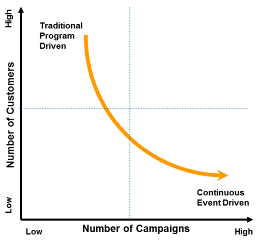
An effective event-driven contact approach has the potential to enable a business to utilise a combination of event triggers to identify, prioritise and conduct marketing. This involves a move from traditional marketing approach (infrequent mass marketing campaigns) to frequent and more precisely targeted campaigns delivered through “intelligent conversations”.
What you find over time is that the business has a differentiated contact and value strategies at the customer micro-segment level, and proactive, well timed and consistent inbound and outbound contacts across channels to influence customer behaviours. In addition, offerings become better matched to the customer needs and preferences at various customer life cycle stages.
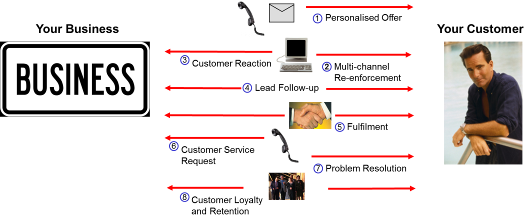
It is vital to ensure that every touch point (every channel) imbeds customer insights to enable ‘intelligent conversations’ with the customer, and to reinforce your business’ brand. Event driven marketing will facilitate two-way conversations with your customers through a combination of channels over the life of the relationship.
If you need help with your marketing strategy and approach then send us an email to see if we can assist — send us a message by clicking here.
|
|
©2010 AC&E International Pty Limited. All rights reserved. | Contact Us | Home | Sitemap
AC&E accepts no responsibility or liability for the accurateness or completeness of any the ideas or information contained in the items or the links on this page – all of the ideas, information and links are provided as items of interest with no assumed direct or indirect liability by AC&E International Pty Limited. The ideas, information and links presented are not intended to be advice given by AC&E International Pty Limited. The reader should be aware that some information may be incorrect, incomplete or out of date when viewed, and is advised to verify the information themselves and seek their own advice before acting or relying upon it.
No part of this site may be copied or reused without express written permission. All intellectual property and trademarks are the property of AC&E International Pty Limited.
|
|
Traditional marketing is driven by an organisation using generic offers targeted at customers selected using predictive modelling techniques and other marketing list extraction methods.
Personalising both the content and the timing of campaigns based on key customer events and customer modelling will result in more relevant marketing campaigns targeting fewer customers (better defined groups of customers).
Rebalancing marketing resources and coordinating customer contact across inbound and outbound channels will require significant change to a business’s marketing focus and competencies (over time). |